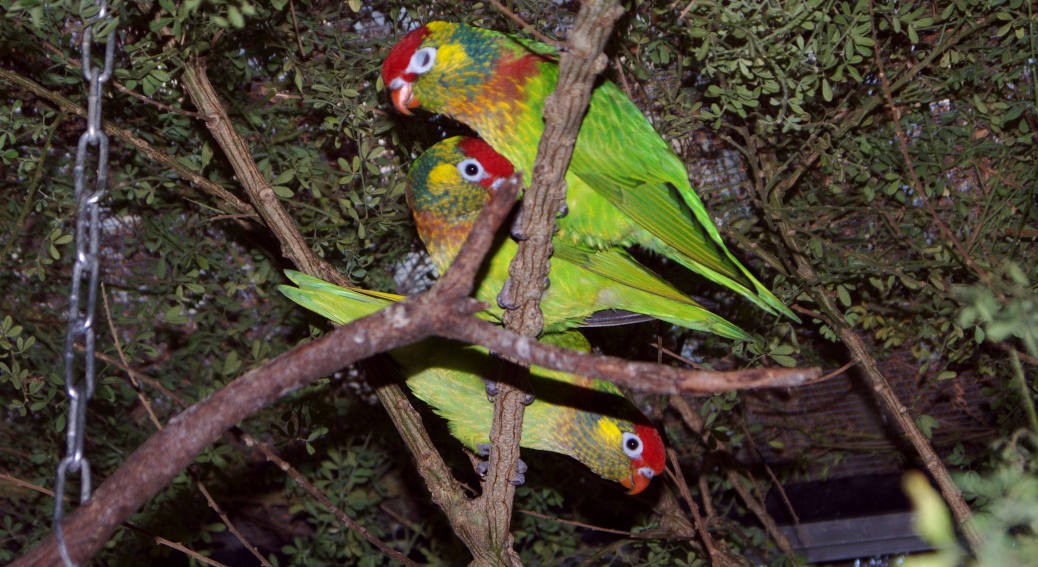
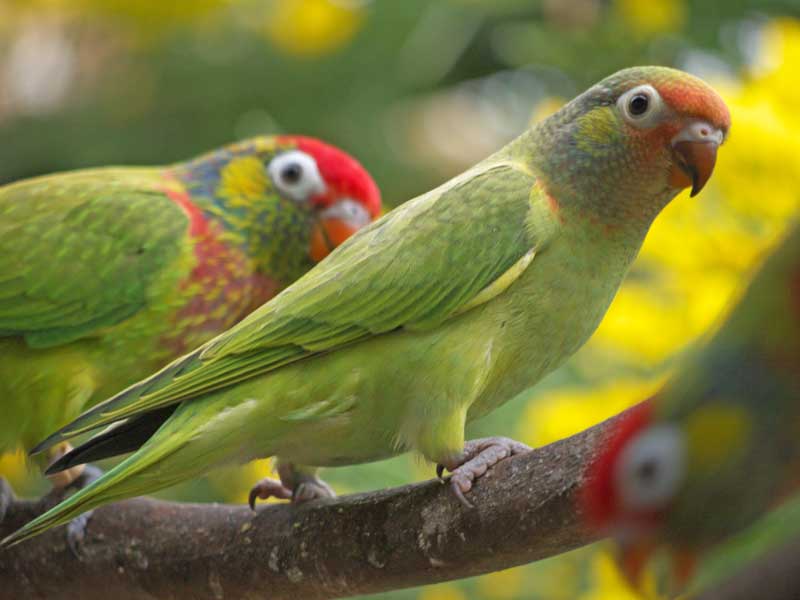
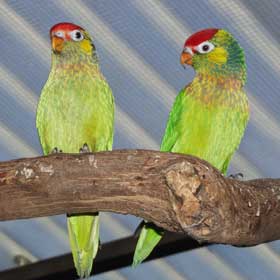
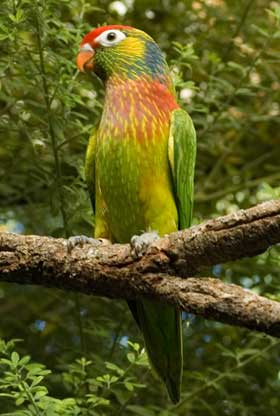
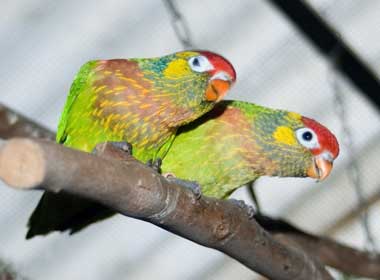
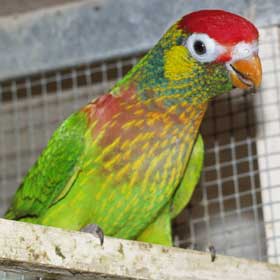
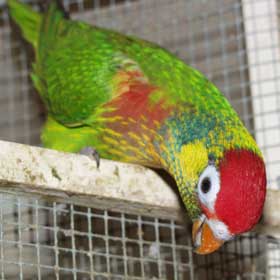
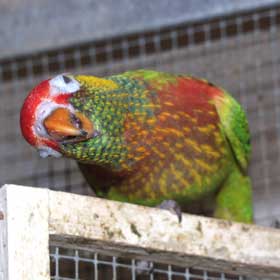
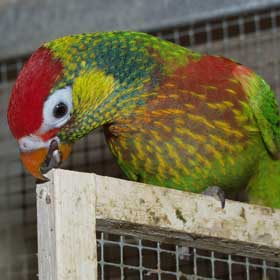
Noisy, cheeky, curious, colourful, occasionally destructive, self opinionated … all words that describe Varied Lorikeets. These gorgeous birds can only be kept with a licence, and require a diet completely different to the seed-eaters. While they certainly can fly quite well, they prefer to walk, climb or crawl through branches whenever possible. They are perfectly happy to hang up-side down from the aviary roof or walls, earning them the unofficial moniker here at Torran of “bat birds”.
Their diet consists of fresh fruit, offered daily, plus lorrie-wet and lorrie-dry. They seem to enjoy picking through the soft food mix offered to the finches in the aviary where they are kept.
Varied Lorikeets are quite good aviary companions in that they can be kept with many other bird species from the smaller and non-aggressive parrots (eg budgies) to finches without any great conflict. They will however merrily tear apart finch nests, either for the fun of it or to stage a take-over bid.
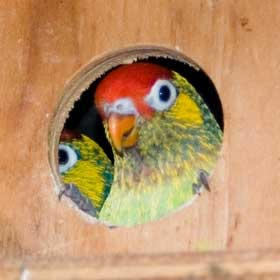
If they are nesting, they will defend their nest-box noisily and with great enthusiasm. Inspecting the nest is best done with care or a good pair of thick gloves as Lorikeets can nip quite hard when and if they want to.
They love Australian native planted aviaries and will enthusiastically feast on the nectar from the flowering shrubs in season.
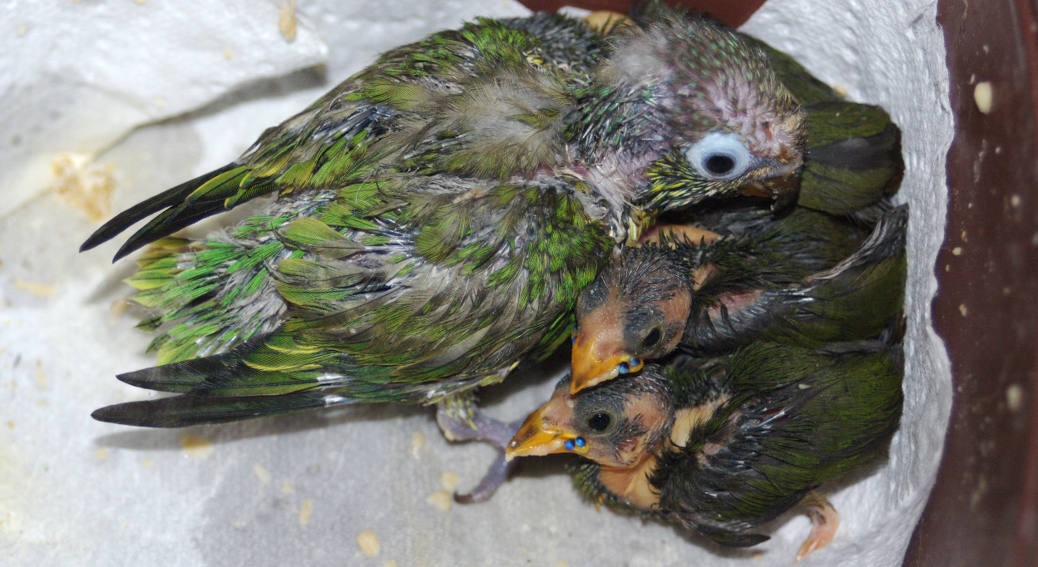
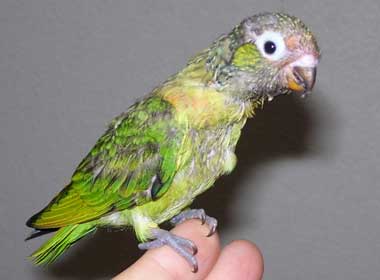
L’rie is an Australian Varied Lorikeet. S/he is the sole surviving hatchling from the most recent nest of my pair of clowns, Stanley and Dee. L’rie is currently being hand raised after spending a cold night alone when on the 23rd of April, at barely two weeks old, its parents abandoned the nest box. Whether they left the box after a night-fright, instinct or just got bored is unknown.
The following morning Stanley and Dee were clowning around on the floor of the aviary, crawling over a hollow log. Given their previous dedication to their nest this was out of character. Upon checking the box I found L’rie cold, blue, hungry and lying on it’s side, unable to stand and beg for food and barely able to move. It was immediately removed from the nest and taken inside to the incubator/brooder box. With a little perseverance I managed to get a small feed into it. Two hours later it was a totally different bird! It’s skin had changed to a healthy warm pink, it was standing albeit a little shaky, and it was hungry.
Now, over a month later, L’rie is growing well. Initially it’s diet was Lorikeet Wet food with a little apple or pear sauce. After some feeding difficulties and further research we started to incorporate some Vetafarm Hand Rearing mix (Neocare) and dropped the fruit sauce. L’rie started responding to food and feeding much better, and the growth rate improved. We started the new regime with a 50:50 parrot hand rearing mix to lorikeet wet mix, and now are currently reducing the ratio of parrot hand rearing mix, increasing the lorikeet wet, while offering a small amount of lorikeet dry in the brooder box throughout the day.
L’rie is developing it’s own bold and inquisitive personality, and is starting to pick a bit at Lorikeet Dry Food that is always available in it’s brooder enclosure. It hates being washed after feeds and would much rather snuggle up and sleep. L’rie is also developing “toilet” habits – preferring not to poop in it’s “nest box”, instead backing up to the door opening and pooping out in it’s “run”.
Update 5th June, 2011
L’rie is doing really well, and has adopted 4 Blue Faced Parrot Finch babies I’ve had to bring inside. S/he still likes to huddle up into my jumper after a feed for a little cuddle. A real sweetie! The feed mix is now about 70:30 lorikeet to parrot hand rearing mix. L’rie is however rather fond of the parrot hand rearing mix and will try to butt in when I’m feeding the Parrot Finches (which are on 100% Vetafarm Neocare Hand Raising Mix).
Update, 13th June, 2011
L’rie is developing a real personality. S/he likes to have a cuddle and “nibble” my hands and fingers after a feed. Loves to go for a “walk” around the house and is developing a very cute personality. The Blue Faced Parrot Finches were moved out to a heated hospital cage in the aviary complex on Saturday, where they have more room to move and a “teacher” older bird – an independent Gouldian Finch youngster – to learn how to eat seed from.
Update, 19th June, 2011
Yesterday L’rie was moved out of the brooder box and into a cage with branches to climb and room to practice wing-flapping. S/he spent his/her first night safely and seems to be having fun exploring. S/he has the insulated “nest-box” from the brooder to retreat to but so far seems less than interested in it. L’rie was given another piece of pear to nibble on yesterday, and a fresh piece this morning. S/he is still taking hand feeding, and has access to both wet and dry lorrie food in the cage.
L’rie’s parents are currently incubating 4 eggs 🙁 It’s still too cold for that silly birds! The nest box cannot just be removed as lorikeets use it to retreat from the cold overnight themselves. We’re currently working on adding some insulating sliding twin-wall polycarbonate panels to separate the covered flight from the uncovered area, so that should at least cut out the worst of the cold, windy weather. These panels work quite well on the Gouldian and Red Faced Parrot Finch aviaries.
Update 27th June, 2011
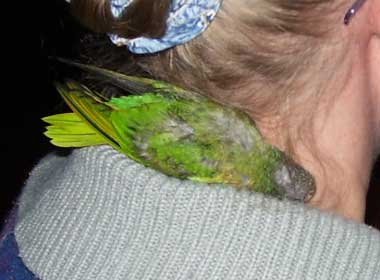
L’rie loves the cage and has settled in well. L’rie loves coming out even more, walking up arms, crawling around shoulders and necks, even snuggling up after a feed and having a nap at the back of my neck. S/he’s taken a few short practice straight line flights without coming to much harm – only flew into a glass window once and not at speed. S/he is still taking hand feeding, and will also feed from the lorrie wet and dry on the cage floor.
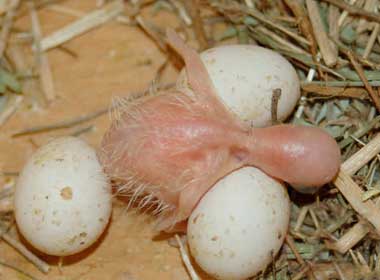
Stanley and Dee have started hatching eggs – first one hatched today. Hope this one fares better, will have to check it daily.
I will keep updating L’rie’s photos here on a weekly basis to keep a record of his/her development.
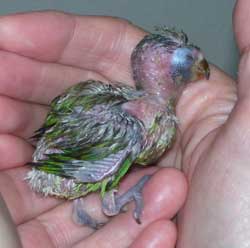
L’rie, 17th April 2011
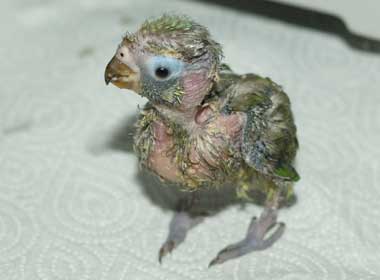
L’rie, 23May 2011
L’rie, 28May 2011
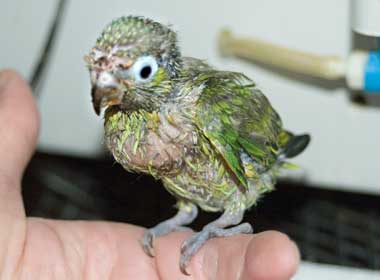
L’rie, 4th June, 2011
L’rie, 11th June, 2011
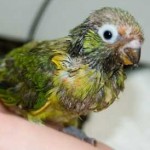
L’rie, 18th June, 2011
PostScript:
L’rie, 25th June, 2011
Shortly after the last photo was taken, L’rie developed an infection that did not respond to treatment, and sadly passes away.
At about the same time, Stanley and Dee had hatched another chick. Given their poor parenting history and the failure of commercial anti-biotics in L’rie’s treatment, I adopted a more holistic approach and researched naturopathic alternatives on the basis that as long as it did no harm it may do some good.
The nest box was inspected daily, much to the chagrin of the occupants. Stanley and Dee became sufficiently obsessive of the box that I had to resort to wearing protective gloves to avoid a nasty nip! The raucous screeching that accompanied their aggressive defense was enough to make ears ring. So much for worrying about them abandoning the nest.
Their daily wet food was modified with the addition of a pinch of powdered garlic (a natural antibiotic and anti-fungal) and kelp (a good source of natural iodine), and a dash of apple cider vinegar (another natural antibiotic great for crop health).
Stan-Dee Jnr, 9th November, 2011.
On the 3rd of November 2011, Stan-Dee Jnr (center) left the nest. Both proud parents keep a close eye on him/her, and they make a truly lovely family group.
Congratulations, at last, Stanley and Dee!
A little history
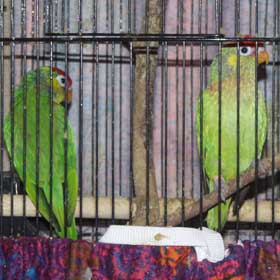
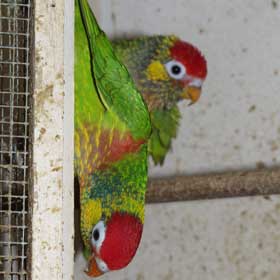
Varied Lorikeets (Psitteuteles versicolor), are endearing, raucous, bold, inquisitive and stunningly beautiful small parrots. L’rie’s parents, Stanley and Dee, are my adorable clowns, but are also so far not the best of parents. Their first nest of eggs back in 2003 were used as toys – tossed out of the nest and rolled around the floor until the eggs broke. As they had not been specifically purchased as a breeding pair, they were housed in cages without nesting boxes after that.
Stanley and Dee, 10th Apr 2003. Initially kept inside in a fairly large cage.Stanley and Dee, 5th Nov 2003. Allowed to play out of the cage in the birdroom.Stanley and Dee, 14th Jun 2007. Plenty of room in a large planted aviary.
When we moved to our 22 acre rural property, Stanley and Dee were housed in one of the new budgie aviaries for a while. They showed no interest in nesting there. When the native shrubs in the finch aviaries started flowering, we moved Stanley and Dee into what is now the Blue Faced Parrot Finch aviary. They loved the seasonal blooms and spent ages crawling over the flowers extracting the nectar.
Stanley keeping his own company while Dee does nest sitting duties, 5th Apr, 2011.
Within a year they started digging holes in the earth floor, under the rocks around a pond. Next thing we knew they were nesting in damp and dirty holes in the ground! They tried to raise 2 nests we know of, but only one egg hatched, a number died-in-the-shell, and the one hatchling was found dead when we dug up the nest after they appeared to abandon it.
At this point I felt if Stanley and Dee were that determined to nest, at least they might be persuaded to use a nest box, high and dry. Then we dug the pond out and relocated the rocks to be sure. Their timing is still lousy thou, and this autumn has been quite cold. Had they nested in summer L’rie may well have survived the night quite comfortably.
So given Stanley and Dee’s past history, I decided it was just not worth the risk to return L’rie to the nest. Not in autumn/winter, and not to this inexperienced pair. Better luck next time guys. Please wait till spring?
L’rie, first to hatch, only a few days old. 17th April 2011.
Stanley and Dee, back in the nest box! 22nd May, 2011.
Stanley and Dee, being raucous. 29th May 2011.
Stanley,
The clown. 5th Nov 2003.
Inquisitive. 5th Nov 2003.
Cheeky. 5th Nov 2003.
Tasty paint? 5th Nov 2003.
Stanley is the biggest clown, but Dee rules the roost. He defers to her when she is about, and when she’s not nesting that’s all the time. They are quite inseparable.
At least two baby Superb Blue Wrens are keeping their parents really on their toes now! They left the nest some time yesterday and are now happily tweeting out to each other while the anxious parents keep watch.
They are constantly on the move, flitting about between the wattles and grevillias. Mum and dad keeping to the higher vantage points as lookouts.
I had one fledgling land only inches away, but by the time I moved the camera up to focus the branch was empty again. Such little sweeties!!!
Update March 1, 2011:
The wren numbers have rapidly jumped from 5 (two adults and 3 young) to over 7. They seem to be quite happy flitting about the garden, through the bushes, shrubs and trees. The dominant male still spends some time each day fighting his reflection …