Dyeing Wool

3 colour way merino roving.

As a designer and mixed-media artist, I relish the opportunity to learn something new, and this week marked the start of my Wool Dyeing course run on-line by Marjie McWilliams through Quilt University.

I had purchased some wonderful 19.5 micron Australian merino wool roving in late 2009 with the intention of either felting or dyeing it. This seemed like the ideal opportunity to put it to use.

The Dye Room

My “Dye Studio” as I loosely call it is a small room attached to my aviary complex. The room is used on a daily basis for aviary maintenance, cleaning food containers and storing all manner of useful things. It has a great, long, multipurpose workbench, a sink with running cold water and lots of storage space. Since my Batik It! class with Marjie in June of 2009 it also has a small LPG stove running off bottled gas. Great for melting bees wax and stewing natural dyes.

The beauty of using this space as my Dyeing room is that I can mix, paint and splash dye around to my hearts content without making a mess in the house. The workbench is covered in plastic, the sink bench is all tile and porcelain, the floor is tile and concrete or tough 2nd hand laminated “timber” flooring. It doesn’t matter if I spill, as it cleans up easily, although it doesn’t really matter if it stained, it would just add “character” to the room.

Day 1, the first Lesson part 1

Armed with Acid Dyes in the basic colours (red, yellow, blue and black), wool roving and lesson instructions I launched into an afternoon of simmering dye with enthusiasm.

I’d worked previously with wool before – a Felting workshop in Corowa and Needlefelting / Whisper Felting course also through Quilt Universtiy. I’d previously dyed cotton, silk, myself and assorted other fabrics and objects with chemically reactive Procion dyes and natural dyes. This was my first attempt at dyeing wool roving and my first serious occasion to use Acid Dyes.

The Acid Dyes we use come in powdered form, and as is Marjie’s way of teaching, we learn to mix our own colours. I found the Acid Dyes strange to mix at first. Cold water instead of the warm water I was used to with Procion Dyes, and unlike Procion Dyes which dissolve reasonably easily, the Acid Dyes behaved more like cornflour – going through a curious semi-gel stage before dissolving in additional cold water.
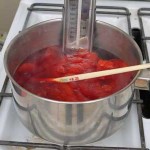
Roving and orange dye.

Getting the dye pot up to and stable at optimum temperature appeared as the first challenge. Just under simmering point eh? Not as easy as it sounds. LPG burns hotter than town gas. The little trivets on my 2nd hand stove top weren’t high enough to keep the pot under the simmer point, which at our altitude (approx 1000′) was happening at somewhere under 180F in the small dye pot. I found I had to keep lifting the pot off the heat to let it cool down. Things were not going too well.
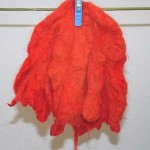
Felted roving.
Felted roving.

Still, at the end of the 30 minutes the roving has taken on a wonderful orange colour from the Dye, and was ready for it’s cool down process. “Gradually” the instructions say. I’ve deliberately felted wool before so I know rapid temperature changes will turn roving into felt. So quickly move the wool from the hot pot to a bucket of hot water … but it doesn’t feel right. It’s felted already 🙁

Back to the class discussion room to ask for help.

Day 2, first Lesson reprise
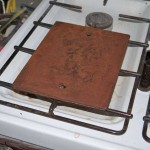
Heat Spreader
Heat Spreader

Knowing from Day 1 we had a problem keeping the heat down, we’d managed to find a piece of rusty steel plate to use as a “heat spreader”. This worked quite well sitting on top of the trivets, keeping the pot further away from the flame. The dye pot wanted to start simmering at 165F, so that became our target. This time I had a lovely sunflower yellow piece of roving that looked really good, that is “un-felted”, in the dye pot.
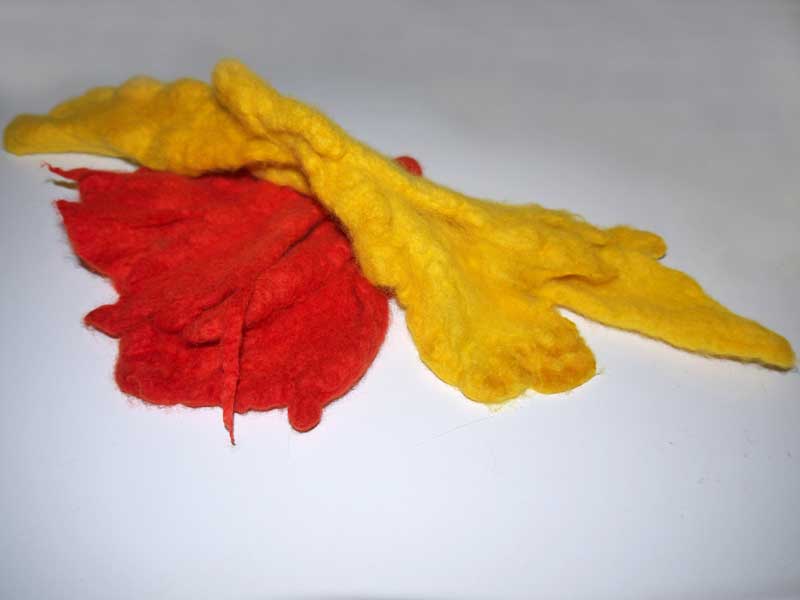
Felted again!
Felted again!

BUT the process of moving it from the hot dye pot to the hot-but-not-as-hot-as-the-pot water bucket, no more than a second or two, was enough to send the roving into shock and it felted! Again!

Ok, challenge number 2 – cooling the roving without it felting. The ambient temperature in the Dye Room was 12.5C (55F), ok, pretty cold. Well, it IS the middle of winter here.

The Options

The first thoughts to come to mind was either adding slightly cooler water to the dye pot, or immersing the whole pot in the hot water bucket, then progressively cool the bucket. Neither likely to be terribly practical with parts 2 and 3 of Lesson 1 which involved gradation dyeing and 3 colour ways with 3 separate jars per roving piece each.

One of the articles Marjie had directed me to from her blog included a comment about leaving the brew for over 3 hours, and that it did not seem to change the dye colour much. Ok, why not leave the roving in the dye pot to cool?

Success!!!
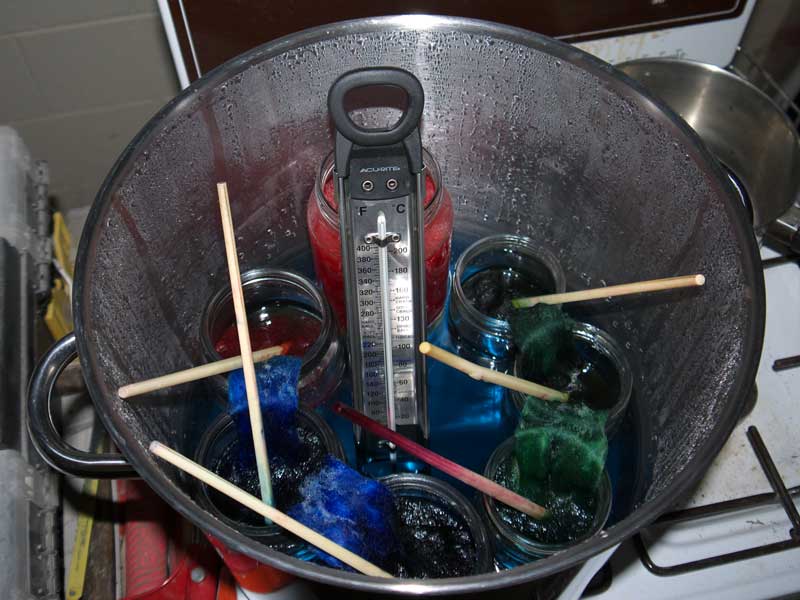
A pot full of dyes.
A pot full of dyes.

Lesson 1 take 3 was a marathon effort – all 3 parts of lesson 1 in my big stockpot at the same time! A solid orange dye/roving; a gradation in shades of green; and 3 colour ways! Each colour had it’s own jar, and the pot itself was filled with water to the highest point I could without the jars trying to float or tip.
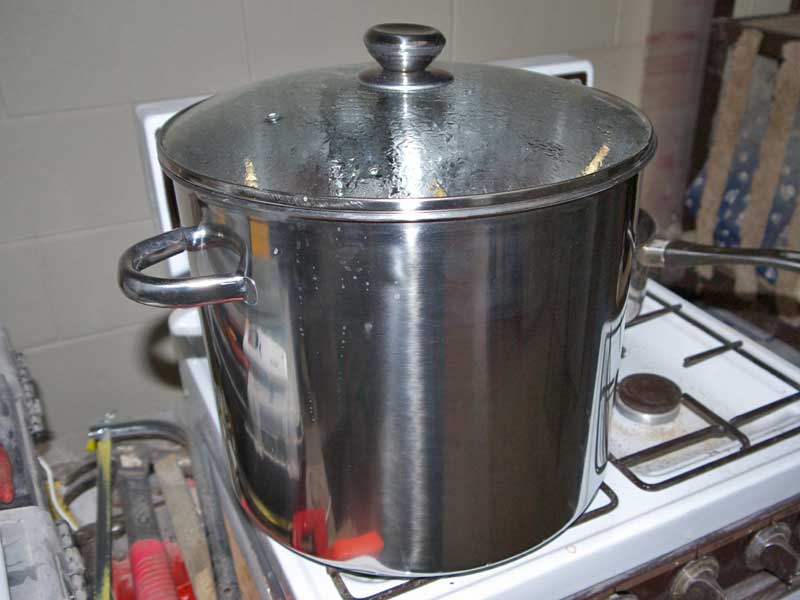
Simmering dye pot, lid "on".

The temperature was fairly easy to manage, and got up to nearly 180F without boiling the pot water. I was concerned about the exposed roving between the jars getting chilled so I kept the lid mostly on the pot, only taking it off to check the temperatures, stir the pot water and spoon (used a 1/2 inch paintbrush actually) the dyes over the exposed wool from time to time.

The orange 3rd attempt at Lesson 1 part 1 did not get much of a stir as I already had two good solid (if felted) colours and wanted to see what not stirring would result in. A little mottling but good colour take-up over all.
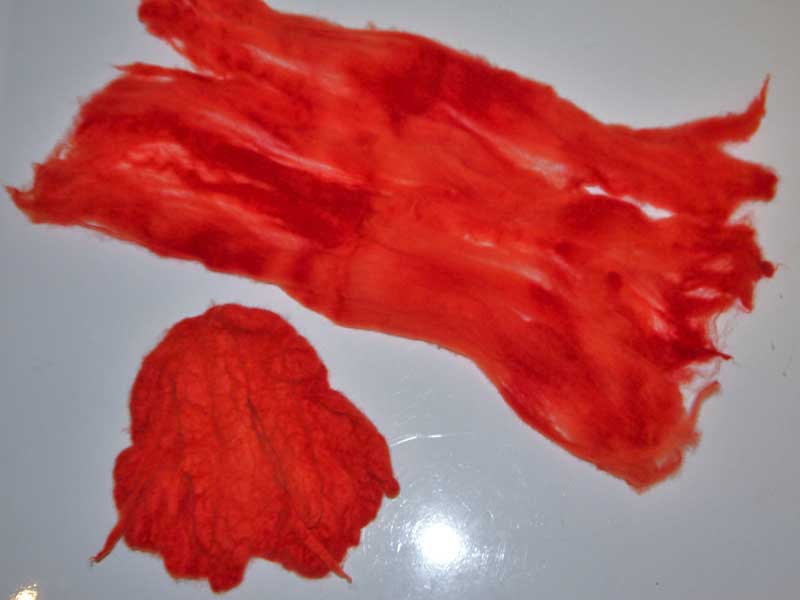
Felted and unfelted roving
Felted and unfelted - the same amount of roving in each!

It took about 7hrs for the big pot to cool to nearly ambient, but it was WONDERFUL to finally see my Australian 19.5 micron merino roving come out of the wash buckets unfelted!!

Now it’s dry it is just so wonderfully vibrant, soft and warm to the touch.

Great result even if it took a while to get there! Looking forward to Lesson 2 next weekend!
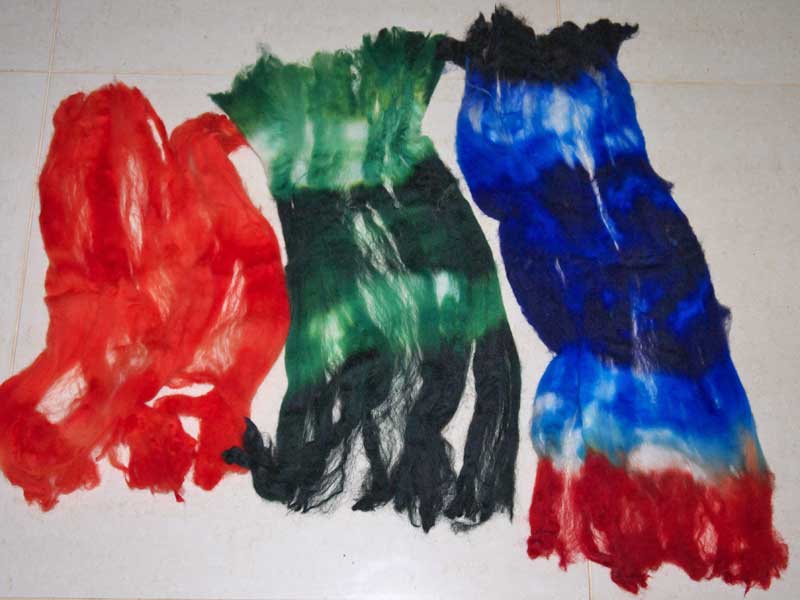
 

Lesson 1 completed - sucessfully!


Winter 2011

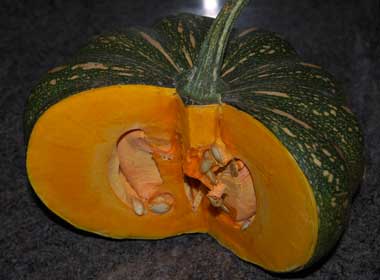
Pumpkins, pumpkins and more pumpkins!

Jap pumpkin, 28th February, 2011

On the last weekend in June we harvested the pumpkins. Over 50 of them!

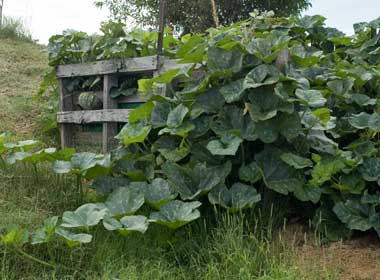
The once lush and invasive vine had started to die well back from the cold, revealing a large area scattered with pumpkins, big and small.

Jap pumkin vine taking over the compost heap. 28th February, 2011.

They had grown, as a lot of great productive vegetables seem to do, from discarded seed in the compost heap.

Over the summer months we watched the vines spread, flower and fruit. Completely taking over the compost heap and surrounds.

We began harvesting the occasional pumpkin for cooking in late summer. Even small they are still very tasty, like squash, and roast and bake well.

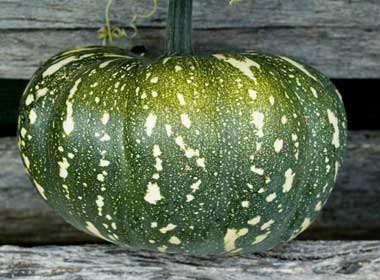
Jap pumpkin, 29th June, 2011.

Through autumn their big full flavour and colour developed. Pumpkin soup, baked pumpkin with roasts and mashed pumpkin with sour cream and butter. Yum!

Jap pumpkins, 29th June, 2011.
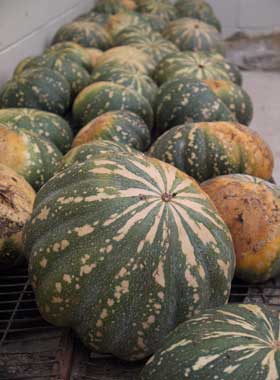
Jap pumpkins in storage, 29th June, 2011.

Now we have more pumpkins than we can eat over the next 6 months they will keep. So what we don’t use, or give away to family and friends, will probably end up back in the compost heap … for next year 🙂

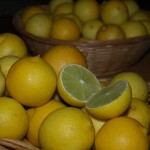
Yes, they really are limes …

Over ripe limes, 29th June, 2011.

The Tahitian lime trees have been extremely productive this year. We’ve been picking limes for Rum Punches and freezing the juice for months. Now the trees are shedding surplus over-ripe fruit.

These were picked up out of the herb garden under the lime tree. A full bucket!

The fruit skins have yellowed, but the insides are still a beautiful lime colour, very juicy and almost sweet.

Rum Punch (for the grown ups)
Juice of 1 lime
Equal quantity of rum
1 teaspoon sugar (or to taste)

Stir till sugar is dissolved. Sip and enjoy!

Lime shot (for all ages – really wakes up the taste buds)
Juice of 1/2 lime
1/2 teaspoon sugar

Stir till sugar dissolves. Our daughter highly recommends it!


Winter Wonders

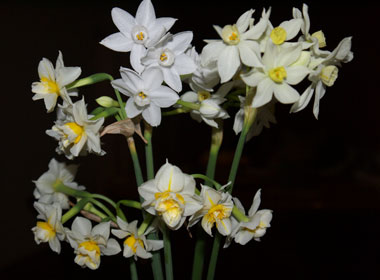
Jonquils starting to flower, 29th June, 2011.

Every year it seems the jonquils flower earlier. Perhaps it only seems that way? So I’ve decided to record when we first notice the “spring bulbs” starting to flower. And this year, 2011, it was the last fortnight in June.

We know the micro-climate here is different to in town. Our Crepe Myrtles flower later, our frosts are less severe and our deciduous trees change colour at different times.

Purple spearmint, June 29th, 2011.

The colder weather has also had an interesting effect on the spearmint. In amidst a lush growth of green, was this eye catching bright purple stem.

Some of the winter flowering natives are in full bloom, and will be added here as I can …


Green Harvest

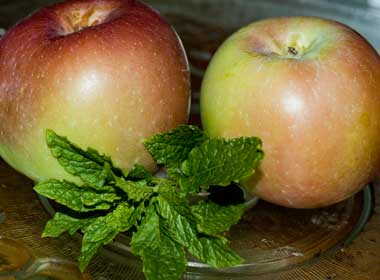
Snow apples and mint, February, 2010

My father was a keen home fruit and vege grower, mum loved her flowering plants. Grandad loved his roses. It’s a family tradition that gets in your blood, or perhaps comes in the genes. So having grown up with home grown fruit, vegetables, and all manner of flowering and non-flowering plants it was only natural we should start to establish our own gardens on our 22 acre plot.

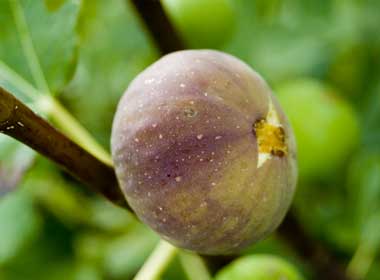
Figs, February, 2011

Recognizing food intollerances that seem prevalent in most families, we opted for following organic principles as much as possible, avoiding chemicals and even seeking out heirloom varieties where we could. Heirloom plants are those that have stood the test of time, have not been genetically modified, and are the basis from which a lot of modern hybrids sprung.

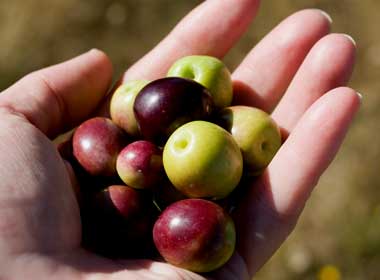
First olives, April, 2011

So far we have harvested home grown organic heirloom strawberries, loganberries, wild blackberries, figs and a small but growing assortment of stone fruits. From these we have made our own jams, sauces, pastes and preserves.

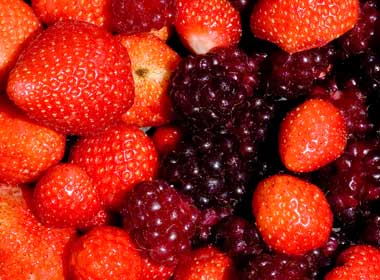
Strawberries and Loganberries, December, 2010

The passionfruit vine we grew from seed and established during the early house build stages has taken over 20 meters or so of the netting fence. It regularly provides tangy passionfruit pulp for pavlovas and passionfruit ice cubes for keeping.

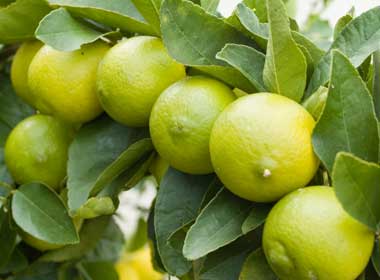
Tahitian limes, May, 2011

Our citrus collection is starting to become heavily productive with Tahitian limes, blood oranges, lemonade lemons and ruby grapefruit. Two old trees we rescued from our city block, a Myer lemon and an orange, have started fruiting again. We’ve had a small handful of mandarins from our tiny mandarin tree, and the lemon tree we grew from seed started to flower for the first time in 2010.

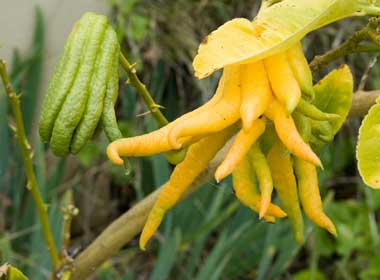
Hand of Buddah
Hand of Buddah, decorative and fragrant citrus. May, 2011

Many of the smaller citrus struggled with the drought and water restrictions. Hopefully with the weather changing they will now start to flourish. This should eventually provide us with two more orange varieties to add to the mix.

The nut trees – almond, macadamia, pine nut and pecan – are growing slowly. The almond may fruit this year, the others are many years away but we look forward to pecan pie and fresh roasted pine nuts some day.

The collection of fruit and berry plants continues to grow in diversity and numbers each year. This year we will add Marionberries, gooseberries, thornless blackberries and raspberries.

Two more juvenile finger limes are growing on in the shade-house nearly ready to join the collection of micro-citrus, the original finger lime the Superb Blue Wrens made their nest in.

The essential herb garden continues to improve with mint, spearmint, Japanese mentha, parsley, golden oregano, chives, thyme and Rosemary. This year we hope to add some purple sage and when the weather warms up a fresh planting of basil.

Being able to harvest fresh fruit, vegetables and herbs from your own organic garden, free from herbicides and pesticides, is an extremely satisfying feeling. It’s not without it’s challenges but the rewards are well worth it.